
 +91 9711442448
 +61 7 3040 1113
 +1 (415) 315-9607
 +64 09 889 0013
+91 9711442448
+61 7 3040 1113
+1 (415) 315-9607
+64 09 889 0013
+64 09 889 0013
+91 9711442448
+61 7 3040 1113
+1 (415) 315-9607
+64 09 889 0013
Hampi is situated in the south Indian state of Karnataka. It is one if the UNESCO World Heritage Sites in India. The city has lot historical and cultural treasures. Hampi is located on the bank of Tungabhadra River, the city is spotted with glorious remains of the 14th century. The ancient monuments present the zenith of incredible skills of sculptures, engravings and architecture.
If stones could have narrate, Hampi will have glorious of tales to tell.The city has historic accounts of the powerful Vijayanagar Empire, it is also mentioned in the legends of Ramayana and in records of the traveller. You can relive the history by knowing about this ancient landscape. You can relax by the river shop for souvenirs.
Hampi got lost in ruins, with the turning wheels of time. Now the city remains destroyed, but the charm is not lost. Some of the top attractions to check out in Hampi are as follows:
Virupaksha temple is one of the most famous structures of Hampi. The temple was dedicated to Lord Shiva as Virupshkaand his associated, the local Goddess Pampa. The temple is one of the finest examples of Vijayanagara architecture, the temple have 38 pillared hall which is carved in the form of mythical lion, The celling is painted in bright colours with the scenes from Mahabharata, Puranas and Ramayana. It also has Shaivite carvings on the base. And don’t miss Nandi Bull statue facing his favourite Lord. Other things that you can see are carved pillars, doors, finely chiselled panels which are dedicated to Goddess Bhuaneshwari.
The walls of the temple are named after Ramayana. The temple is a marvellous example of architecture and art at Hampi. This was the temple for royal families and it was decorated with intricate bas relief that used to narrate the episodes from Ramayana. In the pillared halls, black stones are used to build the pillars. You can visit to holy temple which is dedicated to Devi.
Vitthala Temple is one of the grandest temple in Hampi, it is a 15th century architectural marvel built in typical Dravidian style. Dedicated to Lord Vishnu. There are 3 gateways that give an access to the temple. There is a pillared hall that leads to the small sanctum housing the idol of the deity. There 56 musical pillars, which is the main attraction, they produce melodious music when tapped but is now restricted as they were getting damaged. The exquisitely carved Stone Chariot of Hampi is one of the extravagant creations of its time. Actually a miniature temple, the chariot is formed as a grand vehicle for the procession of idols.
Before the Vijayanagara era, the temple was built at the atop the Hemakuta hill. This temple is a historic treasure in Hampi. It has an expanse of rocky sheets with interesting undulations, this temple is a site that inspire awe. Some of the famous temples are SasivekaluGanesha on the slopes of Hemakuta Hills and KadalekaluGanesha.
The collection of artefacts of the Vijayanagara Empire is stored in the Archaeological museum at Hampi. Things which are displayed are , brass plates,,limestone Buddhist panels,gold and copper coins, , Jain Thirthankaras and sculptures of Hanuman, Lakshmi, Garuda and Ganesha. There are three galleries and sculpture gallery in the museum.
Lakshmi Narasimha is a giant statue of the man-lion God with consort Lakshmi sitting on his lap depicted in a cross legged seated position. It is one of the largest icon of Hampi. The icon “Narasimha” is believed to be one of the 10 avatars of lord Vishnu. It was party destroyed during the enemy invasion.
The best known structure of Hampi is the Queen’s bath which is built with the indo-Saracenic style architecture. It is a square structure which is surrounded by arched balconies and arched pillars. The queen’s bath was made for women of royal household. Water was built by the pipes and it also have lotus shaped fountains that used to shower perfume water.
The Elephant Stables are perfect example of Indo-Islamic style of architecture. These stables were home to the elephant used by royal families on special occasion. There are total 11 rooms, out of which 10 rooms have highly decorated domes.
The lotus Mahal is a 2 story building which is in the shape of a lotus flower. Complete with beautiful archways. The architecture is more of Indo Islamic style. It was later used for musical concert and recreation.
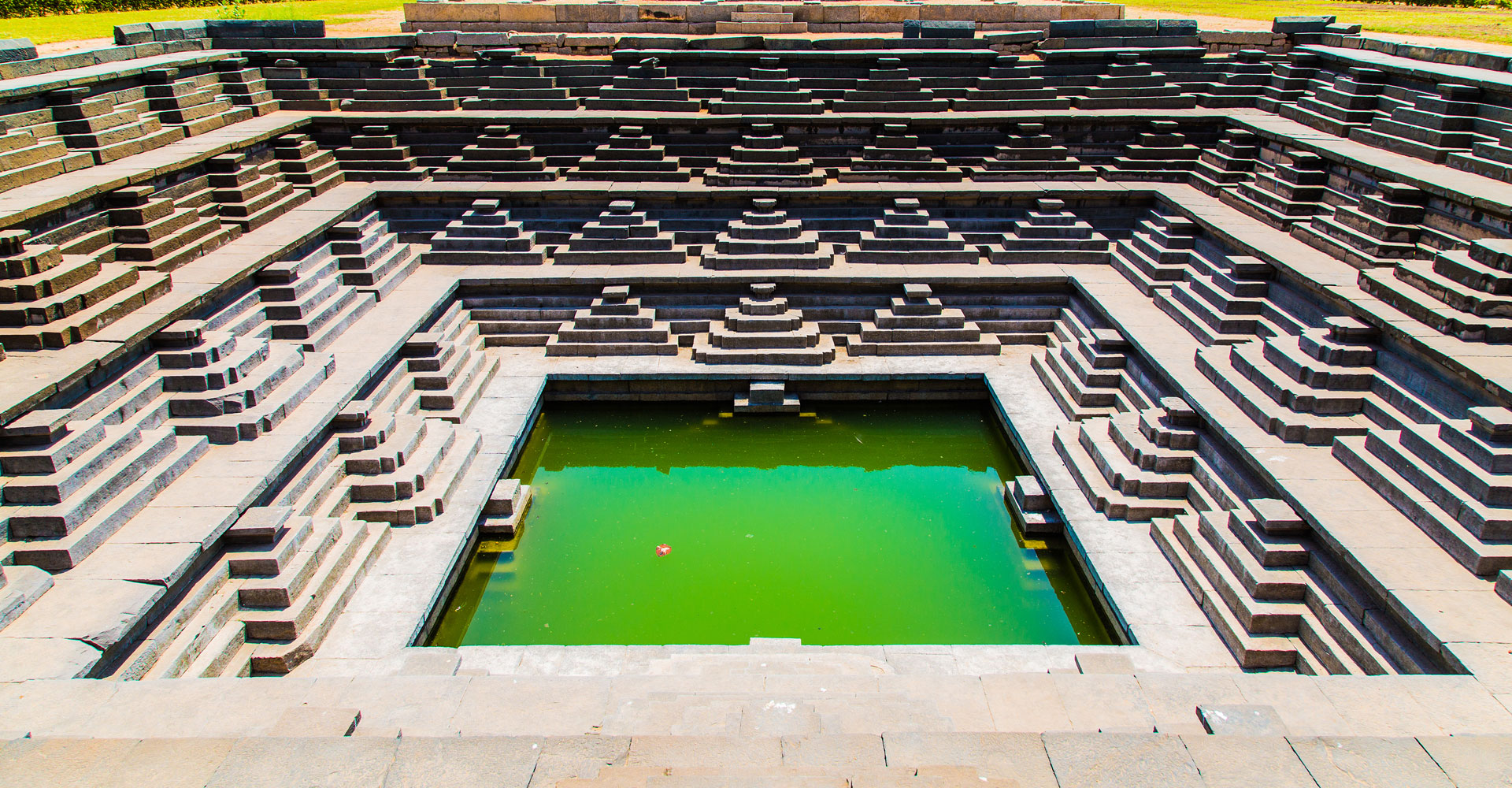
Recently the site was excavated the stepped tank was exclusive masterpiece of black stone. The tank is accessible through 5 tiers of proportionately fitted steps. The stones are relatively small but ornately carved. The stone aqua duct which is well preserved even today is used to water this tank.
The ancient Hampi bazar is connected to Vittala temple by the ruins alongside the River Tungabhadra. The path is spotted with lots of holy places, ruins of ancient structures and carved artefacts. Do not miss the 1008 Siva lingams which are carved in a matrix pattern on a sheet of boulder at the river shore.